|
This Is My Vision of What a Clinical AI Co-Pilot Should Do for the Practicing Clinician at the Point of Encounter
October 2026 | Vol. 70, No. 3
By Michael Eyer, DO, ACOFP, ACEP
USAF Flight Surgeon; Aerospace Medical Association (AsMA); AsHFA (Aerospace Medicine)
Abstract
Artificial intelligence systems are increasingly positioned as clinical decision-support tools, yet most remain limited to static reference functions. This article presents a practical vision of the seven essential capabilities required for an AI system to function as a trusted specialist sitting beside the clinician during the patient encounter, applicable across the full lifespan. These capabilities—universal knowledge access, patient-specific application, full longitudinal chart synthesis, ranked differential generation, suggested evaluation pathways, treatment plan formulation, and on-demand patient education—enable the AI to execute the learnable, intra-category work of medicine while preserving the clinician’s unique capacity to detect category failure. Designed with medical ethics, professional society guidelines, FDA expectations for transparency, and HIPAA requirements at the core, the framework emphasizes continuous human oversight and the explicit preservation of clinical judgment. The result is reduced cognitive load, restored clinician–patient rapport, and a system architecture that keeps signals of misfit visible rather than suppressed.
Keywords: clinical artificial intelligence; decision support systems; cognitive load; differential diagnosis; human–AI collaboration; category failure; patient education; point-of-care.

Figure 1. Conceptual illustration of a clinician working with a real-time AI co-pilot interface during the patient encounter. The system surfaces patient-specific data, differentials, guidelines, and vitals while the clinician maintains primary focus on the patient.
Introduction
Contemporary clinical practice demands that physicians simultaneously retrieve evidence, synthesize longitudinal records, generate differentials, select evaluations, formulate plans, and educate patients—all while building rapport under time pressure. This applies across the lifespan, from neonates to the elderly. Much of this work occurs inside settled diagnostic and therapeutic categories where the mapping from presentation to action is reproducible and therefore learnable. Outside those categories, however, the decisive clinical function is the recognition that the assigned kind may not fit the particular patient.
An AI system that merely supplies generic references leaves the full cognitive burden on the clinician. A system designed as a true co-pilot can execute the settled, intra-category work with speed and transparency, thereby freeing the clinician to occupy more fully the positional role from which discordance between the encoded representation and the living patient can still be noticed and acted upon. This article articulates seven capabilities that together convert an AI from a reference tool into a trusted specialist present at the bedside for patients of all ages. The framework is informed by medical ethics and by theoretical work distinguishing settled categories from the residual judgment required when categories fail.
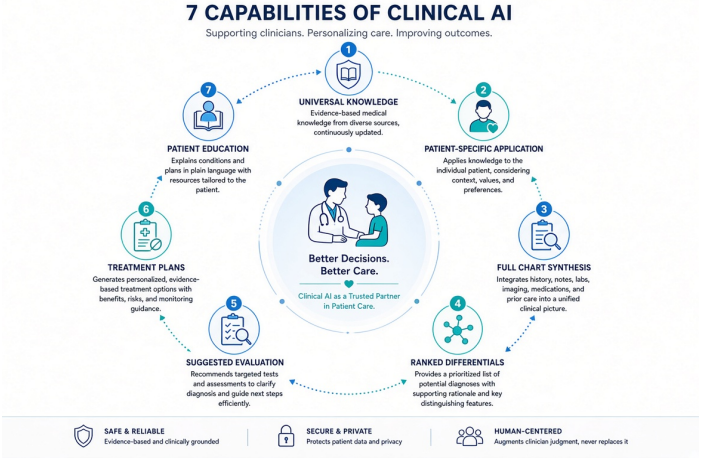
Figure 2. Schematic representation of the seven essential capabilities of a clinical AI co-pilot, organized as an integrated, continuous presence supporting the clinician–patient relationship across all age groups.
The Seven Essential Capabilities
1. Universal Medical Knowledge
The system provides instantaneous, evidence-based access to current literature, guidelines from major professional societies (AAP, ACP, AAFP, specialty organizations, USPSTF, CDC), drug information, and best practices. Synthesis is dynamic rather than static. Every claim is accompanied by its source and strength of evidence, enabling rapid verification. This function is most powerful where medicine has already fixed its categories; the decision mapping becomes a learnable function that can be executed consistently and at scale across the lifespan.
2. Patient-Specific Application
Knowledge is never delivered generically. It is immediately applied to the unique patient—age, developmental or functional stage, weight, comorbidities, medications, allergies, recent laboratory values, social determinants, and the reason for the present visit. For example, an older adult with heart failure and recent viral illness receives the latest guideline-directed medical therapy recommendations plus evidence specific to decompensation triggers, tailored to that patient’s actual history, renal function, and goals of care. This keeps the settled rule connected to the particulars of the patient in the room.
3. Full Longitudinal Chart Synthesis
Within seconds the system reviews the entire longitudinal record—notes, laboratories, imaging, consultations, growth or functional status trends, immunization or preventive care history, prior hospitalizations, and care plans—and surfaces only the elements relevant to the current encounter. Prior response patterns (“Similar presentation eight months ago responded well to X but produced side effects from Y”), trajectory of chronic conditions, and social context are recovered and correlated. Structured electronic records inevitably omit information that previous objectives did not deem relevant; full synthesis works against that loss by restoring narrative and response history at the point of care for patients of any age.
4. Ranked Differential Diagnoses
A ranked differential is generated from the current presentation plus the full chart and is updated dynamically as new information emerges during the visit. Each diagnosis is accompanied by the clinical logic that produced its rank, together with supporting and contradicting data drawn from specific chart elements. High-stakes (“must-not-miss”) conditions are explicitly flagged, with age-appropriate considerations (e.g., atypical presentations in the elderly or neonates). By making both supporting and contradicting evidence visible, the differential becomes a working surface on which the clinician can detect when the patient is not adequately represented by the category the system has proposed.
5. Suggested Further Evaluation
The system recommends the most appropriate next steps—laboratories, imaging, referral, or observation—prioritizing diagnostic yield while weighing radiation or procedural risk, sedation or contrast needs, cost, and practical logistics for the patient and family or caregivers. Evidence-based rationales and alternatives are always supplied. Recommendations remain proposals; thresholds are never converted into mandatory actions, thereby preserving space for the clinician to decide that the governing category itself may be the wrong frame.
6. Treatment Plan Recommendations
Evidence-based therapeutic options are tailored to the individual patient and linked transparently to source guidelines. First-line and alternative therapies, age- and weight- or renal-adjusted dosing, interaction and contraindication alerts, duration, monitoring parameters, and clear escalation or de-escalation triggers are provided. Because departure from settled pathways is often highly visible and attributable, the system is designed to make evidence and alternatives legible rather than to enforce a single path. The clinician retains full authority to accept, modify, or decline every recommendation, incorporating patient values and goals of care.
7. On-Demand Patient Education
Clear, age-appropriate, and literacy-level-appropriate explanations are generated from the actual discussion that has just occurred. Outputs include concise after-visit summaries, plain-language descriptions of diagnosis and plan, medication instructions, red-flag warning signs, and visual aids when needed. Education that matches the decisions actually made—rather than a generic handout—narrows the gap between the documented plan and the patient’s (or family’s) understanding, supporting adherence and safety across the lifespan.
How These Capabilities Transform the Encounter
With chart synthesis, differential ranking, and evidence application handled in the background, the clinician’s attention returns to listening, examining, and relating to the patient. Eye contact and conversation replace prolonged screen time and the mental juggling of guidelines. Cognitive load associated with settled-category work is lifted; the residual, non-automatable function of judging whether the category fits remains firmly in human hands—whether the patient is an infant, an adolescent, a working adult, or a frail elder.
Transparency, Guardrails, and Human Oversight
The architecture is aligned with three non-negotiable requirements:
Medical ethics and professional guidelines—patient-centered care, shared decision-making, and age-appropriate considerations are embedded in every recommendation layer.
FDA expectations for clinical AI—full transparency of reasoning, clear intended use, and continuous human oversight at every decision point.
HIPAA and data governance—secure processing, minimal necessary access, and complete auditability of every suggestion.
No silent actions and no auto-orders are permitted. Every recommendation is offered for the physician to accept, modify, or decline. This is not residual courtesy; it is the design acknowledgment that the clinician occupies the unique position from which encoded and unencoded information can be compared and from which category failure can still be detected.
Preserving the Capacity for Self-Correction
Where categories are settled and liability is salient, displacement of routine decision functions is both expected and, when performed transparently, beneficial. The design priority is therefore twofold: execute the reproducible mapping inside settled categories with excellence, and keep the signals of potential misfit visible so that judgment about the category is neither privatized as individual risk nor suppressed by compliance pressure.
A natural next step consistent with this logic is a structured mechanism for documenting category misfit—the assigned category, the observation that does not fit, the alternative explanation or mechanism, and the consequence for management—so that recurrent signals can become reviewable research questions rather than disappearing from the record on which future systems learn.

Figure 3. Illustration of the intended relationship: the AI functions as a specialist sitting beside the clinician, supplying knowledge, synthesis, and options while the physician retains final authority and the capacity to notice when the decision space itself may be wrong—applicable across all ages and clinical settings.
Conclusion
An AI system that delivers the seven capabilities described here ceases to be a mere reference tool and becomes a continuous, transparent presence at the bedside for patients of every age. By handling the learnable work inside settled categories, it restores the clinician’s capacity to focus on the patient—and to remain positioned to recognize when the category itself is inadequate. The result is not the replacement of clinical judgment but its preservation and amplification under the real conditions of contemporary general medical practice. This is the vision of a true clinical AI co-pilot at the point of encounter.
About the Author
Michael Eyer, DO, ACOFP, ACEP is a physician in the greater Baltimore area, an aerospace medicine specialist, and clinical researcher with nearly five decades of continuous practice. He is Board Certified in Family Medicine and Emergency Medicine, with specialty qualification in Aerospace Medicine. Career highlights include service as a U.S. Air Force Flight Surgeon and Clinical Research Fellow at the U.S. Air Force School of Aerospace Medicine (USAFSAM), where he contributed to NASA astronaut candidate evaluations.
As a member of the USAFSAM aeromedical evaluation team, he participated in the final-phase medical and psychological screening of the 208 finalists for NASA Astronaut Group 8 (the “Thirty-Five New Guys”), announced in January 1978. His team contributed to the psychological, psychiatric, and specialized physiological evaluations required for the demands of space travel.
He later commanded clinical operations as Flight Surgeon for the 49th Fighter Interceptor Squadron and served as Chief of Emergency Medicine and Primary Care at Griffiss Air Force Base. He contracted with the Department of Defense and served as Chief of Primary Care at several military hospitals. In civilian practice, he continues as a board-certified Family Physician and Medical Director at LifeBridge Health. He is currently a researcher developing platforms for clinical decision support and biomedical research while advancing the integration of artificial intelligence into healthcare delivery.
References
1. Agostini K. Settled Kinds: Why Clinical Artificial Intelligence Displaces Judgment Where Medicine Has Fixed Its Categories. Preprint, SSRN (2026). https://ssrn.com/abstract=7233399
2. American Academy of Pediatrics; American College of Physicians; American Academy of Family Physicians; and other specialty society clinical practice guidelines (current editions).
3. U.S. Food and Drug Administration. Guidance on clinical decision support software and artificial intelligence/machine learning-based software as a medical device (current).
4. Relevant HIPAA Security and Privacy Rules governing electronic protected health information. |